
Advanced spine assessment
Find out what is actually causing your back or neck pain
A thorough clinical spine assessment, built by spine surgeons. The interview adapts to your answers the way a specialist would, reads your MRI, CT and X-ray reports, and explains in detail what is most likely driving your symptoms.
Free. About 8 minutes. No card, and nothing to cancel.
- Built and tuned by spine surgeons
- Tested against a 162-scenario clinical library, including the presentations that must not be missed
- In evaluation at multiple large academic medical centers
- HIPAA-standard handling, encrypted end to end
- 271
- clinical questions in the bank, asked adaptively so you only answer the ones that apply to you
- 13
- assessment domains, with the neck, mid-back and lower back on separate clinical paths
- 8 min
- typical time to complete, including reading whichever imaging reports you upload
Built on the published guidelines
The clinical logic follows recommendations published by the major spine, neurosurgical and musculoskeletal bodies in North America, Europe and internationally.








These organizations publish the clinical guidelines the assessment draws on. They are not affiliated with SpineSense and have not reviewed or endorsed it.
What the assessment tells you
What is most likely causing this
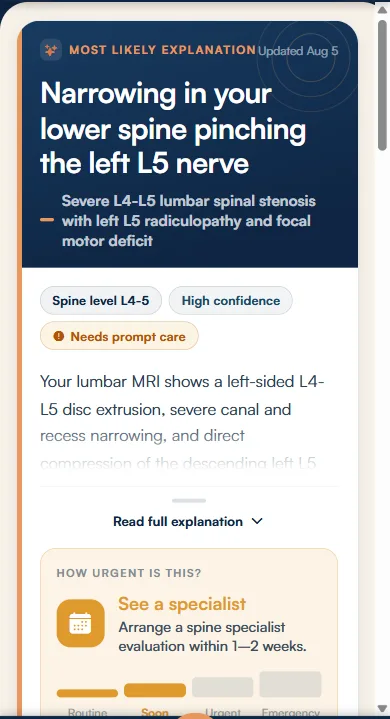
The analysis names the clinical patterns your answers and your imaging fit, explains what each one means, and says which findings actually line up with what you feel and which are probably incidental.
Why your symptoms are where they are
Which nerve level would explain pain running down the back of one leg. Why one hand goes numb and the other does not. Why sitting helps and standing does not. The reasoning is shown, not just the conclusion.
What your MRI report is actually saying
Disc desiccation, foraminal narrowing, Modic changes, facet arthropathy. It reads the written report and puts it in plain language next to your symptoms, so you can see which lines matter and which are ordinary for your age.
How soon this should be looked at
Where your pattern sits on the urgency scale, which specific features would change that, and the questions worth putting to your clinician when you are seen.
What you get back
How the assessment works
- 01
You describe the problem in your own words
Talk or type. Where it hurts, when it started, what makes it worse. Nothing here is a checkbox list of five options, because that is not how anyone describes their own pain.
- 02
It asks the questions a specialist would ask
A 271-question clinical bank across 13 domains, delivered adaptively: it tracks what it already knows and asks only what it still needs to separate one explanation from another. Neck, mid-back and lower back follow separate clinical paths, the way they do in clinic.
- 03
It reads the records you already have
MRI reports, clinic notes, X-ray results: a PDF, a photo of the page, or pasted text. It extracts the findings and reconciles them against what you described. Optional, and the assessment works without it.
- 04
You get the analysis, in full
The likely explanations in order, the reasoning behind each, how confident the analysis is, how soon people with this pattern are usually seen, and what to raise at your appointment.
Why it was built
SpineSense was built to give spine patients a real understanding of what is happening in their own back, and the detail they need to be taken seriously when they ask about it.
Spine problems are unusually hard to pin down, and the person holding the least information is almost always the patient. You feel something specific and complicated, and you get a few minutes to explain it. The MRI report is written for another doctor. Nobody has the time to draw out the details that would actually narrow it down: whether it is worse sitting or standing, how far down the leg it travels, which two fingers went numb, what changed in the last month.
This does that part properly, with no clock running, and then explains what it found in language written for you rather than for a chart. The point is that you understand your own spine, and that you and your doctor make the decisions about your care with the same picture in front of both of you.
Your health information stays yours
Handled to HIPAA standards
The same rules a clinic is held to, applied to everything you enter and every document you upload.
Encrypted in transit and at rest
Your answers and your records are encrypted on the way to us and while they are stored.
No advertising or third-party trackers
There is no ad-network pixel and no third-party analytics tag anywhere in the assessment. Nothing about your health leaves our own infrastructure.
Your documents stay yours
Anything you upload can be removed later, from inside your account.
Bring an AI scribe to your appointments
Doctors use AI scribes to take notes. MyScribe gives you the same help on your side of the visit. Record an appointment with your clinician's permission, and it keeps an organized summary of what was said, what was recommended, and what comes next, so you can revisit the details and compare opinions later. It is part of the same free account.
Always get your clinician's permission before recording.
Start when you are ready
Free, about 8 minutes, and no scan is required to begin. If you would rather read first, the SpineSense library has sourced guides to every spine condition and procedure, and needs no account.